

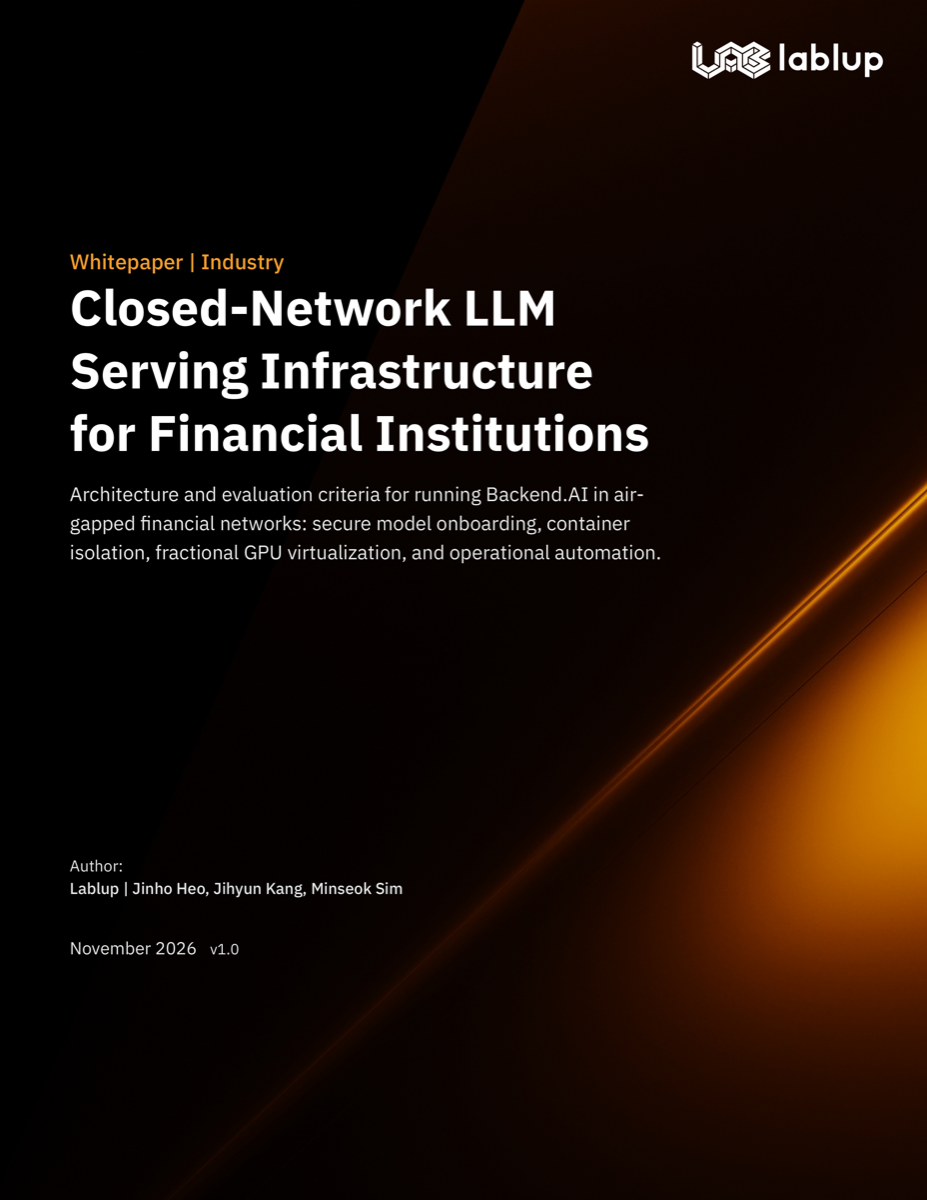
Closed-Network LLM Serving Infrastructure
for Financial Institutions
Architecture, validation results, and evaluation criteria for multi-model serving in air-gapped environments

As generative AI expands across customer support, underwriting, and document processing, financial institutions must run multiple models of different sizes concurrently inside network-separated environments. This whitepaper outlines the criteria to evaluate alongside hardware specifications—air-gapped model onboarding and isolation, fractional GPU virtualization, and operational automation—along with validation results from serving 12 financial workload models on a single 8-GPU H100 server instead of the 17 GPUs dedicated allocation would require.
What Should Financial Institutions Evaluate for Closed-Network LLM Serving?
When financial workloads handle personal credit records or internal policies—such as underwriting, credit evaluation, and customer support—data cannot leave the internal network, making on-premises closed-network LLM serving essential. In practice, generative AI services rarely stop at a single chat model; they combine embedding and reranker models for document search with vision models for document processing. Dedicating one full GPU per model leaves idle capacity growing with every model added, while handling onboarding, scaling, failure recovery, and audit evidence manually quickly becomes unsustainable—making the operating platform just as critical as server hardware.
This whitepaper organizes the core evaluation requirements into three areas: closed-network operations and isolation, GPU resource efficiency, and operational automation. It walks through how Backend.AI onboards and scans external models under administrator approval through Reservoir AI without internet access, and meets security audit requirements with per-session container isolation, corporate SSO integration, and automatic audit logs. It also covers how fractional GPU virtualization packs models of varying sizes onto shared GPUs alongside automatic idle session reclamation and multi-node cluster sessions for large models within the same cluster.
The whitepaper also examines how platform automation reduces day-two operational overhead. It details Preset-based model deployment, business-hour auto-scaling, and automatic failure recovery, as well as hierarchical quota control and usage accounting across affiliates and departments. For organizations that require per-department token chargeback and unified gateway policies, it outlines how Backend.AI extends with Continuum Router and Continuum Hub.
Alongside architectural guidance, the paper reports five-week validation results from serving 12 financial workload models (14 replicas) concurrently on a single 8-GPU H100 80GB server. See the full whitepaper for memory isolation tests under dense fractional packing, measured idle reclamation, scaling, and recovery times, a comparison of GPU partitioning methods, and a deployment compatibility checklist.
Download Resource
Please fill out the form below.
Related Services

Backend.AI is a vendor-agnostic accelerated workload hosting platform based on our own home-grown orchestration and job scheduler, running on top of either cloud or on-premises (air-gapped) clusters.
Explore service →Continuum Router
A lightweight LLM gateway that receives requests through an OpenAI-compatible API, selects a backend by prompt prefix, and enforces request policy.
Explore service →Continuum Hub
A control plane that manages the policies, API keys, and costs of Continuum Routers deployed across multiple sites under a single standard.
Explore service →