

Slurm Frontend:
Run Existing Slurm Jobs
on Backend.AI, Unchanged
Slurm Frontend's architecture, command and concept mapping, job isolation, and supported environment

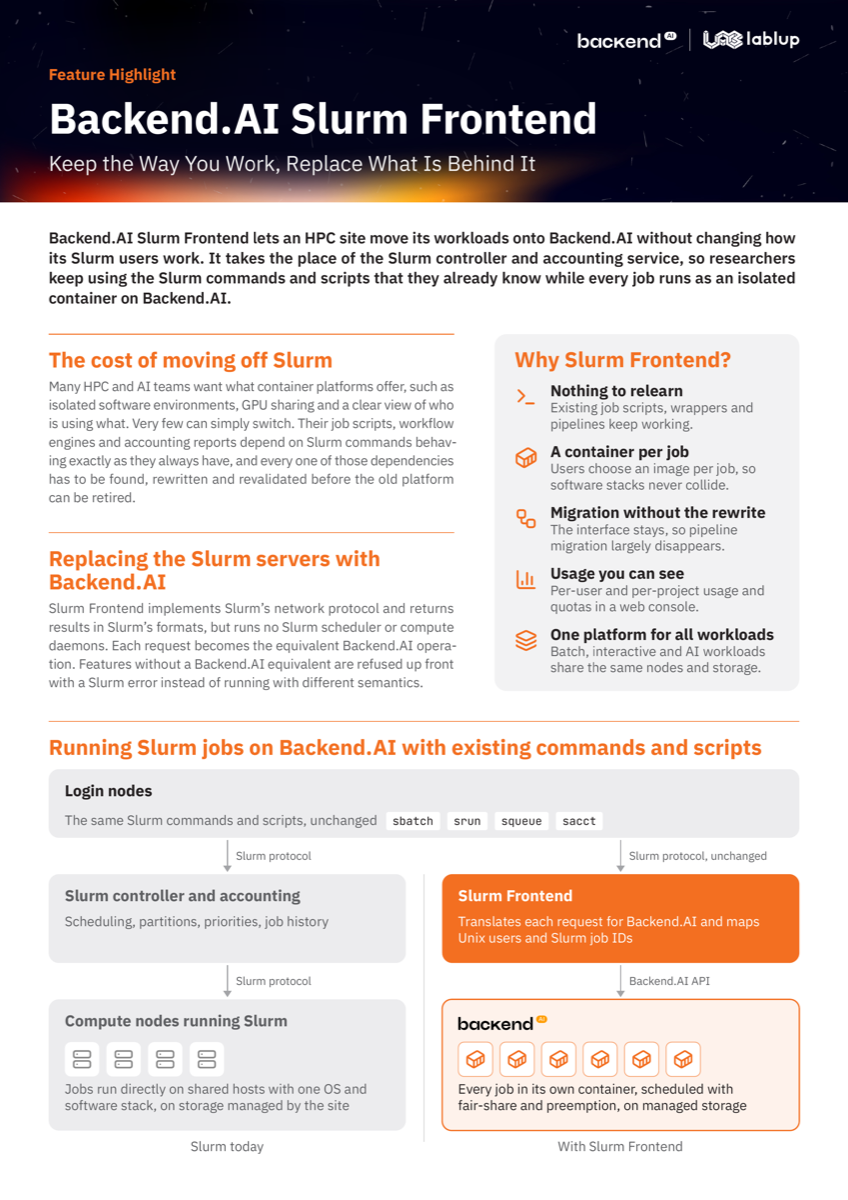
Backend.AI Slurm Frontend takes the place of the Slurm controller and accounting service and runs every job in an isolated container on Backend.AI. Researchers keep using the Slurm commands and job scripts they already know. Learn how HPC workloads move to Backend.AI without rewriting job scripts or workflow engines, how Slurm commands and concepts map onto Backend.AI, and how each job gets container isolation and hardware access.
Who Is This Document For?
This document is written for HPC center operations teams and infrastructure engineers who run Slurm clusters and are evaluating a move to a container platform. It is especially suited to research institutes and university computing centers whose job scripts, wrappers, workflow engines and usage reports depend on Slurm commands behaving exactly as they do today. Organizations that want batch, interactive and AI training or inference workloads to share the same nodes and storage, or that need per-user and per-project usage and quotas in a web console, can also evaluate it.
Slurm Frontend receives requests over the Slurm network protocol, runs each one as the equivalent Backend.AI operation, and returns results in Slurm's formats. Each job runs in a container from the image the user chooses, under the submitting user's Unix identity. Backend.AI's scheduler places Slurm jobs with fair-share and preemption, and on NVIDIA GPUs, Container-level GPU Virtualization lets Slurm jobs and other Backend.AI workloads share a single device in fractions. See the full document for per-command coverage, the mapping of Slurm concepts to Backend.AI, hardware access for MPI and NCCL workloads, and the supported environment.
Related Services

Backend.AI is a vendor-agnostic accelerated workload hosting platform based on our own home-grown orchestration and job scheduler, running on top of either cloud or on-premises (air-gapped) clusters.
Explore service →